


Motorcycle Tire
What is Motorcycle Tire?
A motorcycle tyre is the outer part of motorcycle wheel, attached to the rim, providing traction, resisting wear, absorbing surface irregularities, and allowing the motorcycle to turn via countersteering. The two tyres' contact patches are the motorcycle's connection to the ground, and so are fundamental to the motorcycle's suspension behaviour, and critically affect safety, braking, fuel economy, noise, and rider comfort.
Advantages of Motorcycle Tire
Safety
Quality tires provide better grip and braking capability, ensuring safer riding in emergency situations and on slippery roads.
Riding comfort
Quality tires can enhance riding comfort by providing a smoother ride and reducing vibrations, which is crucial for long-distance journeys.
Durability
Quality tires offer a longer lifespan and may require less frequent replacement, leading to cost savings.
Fuel efficiency
Tires with lower rolling resistance, often found in quality tires, can improve fuel efficiency, resulting in lower fuel costs.


Why Choose Us
Our Factory
As a professional tire and inner tube factory with 30 years of industry experience, Shandong INKLIDA Co., Ltd takes advantage of high-quality products and superior transportation conditions close to Qingdao Port. After more than 30 years of development, it has received widespread praise from customers around the world.
Production Market
Our products are available in over 40 countries worldwide and have received high praise from customers! e.g. South America, North America, the Middle East, Asia and and so on.
Our Certifications
We have passed lS09001 IS014001 0HSAS18001 System certifications, all the test reached GB7036.1-2009 standards.
Our Services
Our team boasts extensive industry experience,Accept OEM and ODM services,Strict inspection and 3 times 100% test before ship, 7-15 work days delivery time.
Types of Motorcycle Tire
Sport bike tires
Racing slicks won’t do the trick; they don't hold up well against the oils and debris on public roads. They’re also made to run at racing-hot temperatures, so they'll turn into ice skates in slow traffic. Racing slicks are illegal too, if you care about that kind of thing.But there are some grippy and agile street-legal tires out there, which are specially built to warm up at roadway speeds. This will let you scrape some knees without scraping every other part of your body too.
Touring tires
They are similar to sport tires, but will have a slightly flatter profile for more straight-line stability. The rubber will also be made from a harder compound. This hinders the grip a bit, but has large gains in terms of longevity. Some touring tires have a high-profile, bias-ply construction. You'll normally see these types on larger bikes, which need a bias-ply tire to handle the mammoth weight. As a bonus, bias constructed tires are better at soaking up the bumps.
Cruiser
For that robust style, many cruisers will spec a mile-wide tire. Larger bikes May tend towards high-profile tires to give a superior ride quality. However, some smaller cruisers are geared towards performance use. In these cases, a sporty tire is better suited.
Adv tires
Adventure riders need a lot from a tire. It has to be smooth on the highway, yet with a deep enough tread pattern for off-road use. It has to be comfortable for long days in the saddle, yet aggressive enough for edging into a corner. Plus, you’re going to be loading your bike with everything from tent poles to jerry cans. That means the tire will need a fairly high load capacity as well.
Dual-sport tires
Dual-sport tires are essentially street-legal off-road tires. They’re hard enough so that, after a few hours on the pavement, they won’t be bald. That said, you wouldn't want to take them on extended highway trips. The on-road ride quality is poor, and generally quite noisy. Also, leaning a dual-sport tire into a corner can have messy consequences.
Off-road and motocross tires
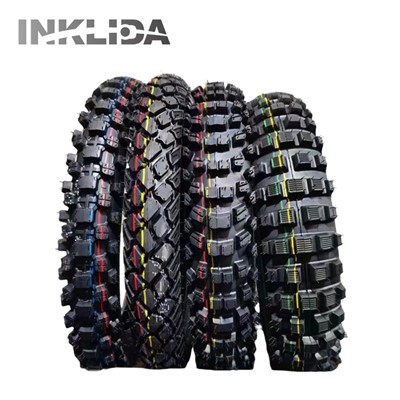
If you’re a true off-road rider, then your motorcycle only sees pavement from a trailer or a truck bed. That means its tires can be solely committed to the dirt.Motocross tires are very knobby, and provide exceptional traction in soft terrain. The tread also wraps around the sides, jutting out at an angle to the central knobs. This maintains grip while leaning into a sharply-angled berm.
Materials Used in Motorcycle Tire


Rubber compounds
The rubber compound is the heart and soul of any motorcycle tire. It is the part of the tire that comes into contact with the road surface and provides the necessary traction and grip. The rubber compound is made up of several ingredients, each with its unique properties and functions.
Natural rubber
The primary ingredient in the rubber compound is natural rubber. Natural rubber is derived from the sap of the hevea brasiliensis tree, which is primarily grown in southeast asia. The sap is collected by making small incisions in the bark of the tree and allowing the sap to flow out. The sap is then collected in cups and taken to a processing plant, where it is turned into usable rubber.
Synthetic rubber
In addition to natural rubber, the rubber compound also contains synthetic rubber. Synthetic rubber is made from petroleum-based chemicals and is used to improve the durability and performance of the tire. Synthetic rubber can be tailored to meet specific performance requirements, such as increased grip or reduced rolling resistance.
Carbon black
Carbon black is another critical ingredient in the rubber compound. It is a form of carbon that is produced by burning petroleum products or natural gas. Carbon black is added to the rubber compound to improve its strength and durability. It also helps to reduce heat build-up and improve the tire's resistance to abrasion.
Silica
Silica is another ingredient that is often added to the rubber compound. It is a mineral that is extracted from sand or quartz and is used to improve the tire's grip and handling. Silica is often used in conjunction with carbon black to balance the tire's performance and provide optimal handling and wear.
Antioxidants
Antioxidants are added to the rubber compound to protect it from deterioration caused by oxygen and ozone exposure. Antioxidants help to prevent cracking, dry rot, and other forms of damage that can occur over time.
Processing aids
Finally, the rubber compound also contains processing aids that help to improve the manufacturing process. These processing aids can include oils, waxes, and other compounds that improve the flow of the rubber during the manufacturing process.
Process of Motorcycle Tire
Mixing raw materials into usable compounds
Natural rubber is “milky white latex” that comes from special rubber trees grown in thailand. Natural components usually produce strong smell at the production plant, because rubber is natural fat and it starting decaying when mixing process begins. On the other hand, synthetic rubber based on petroleum, doesn’t have any significant acrid smell. Each rubber type has its own advantages for the various parts of motorcycle tyre.
Large pieces of natural and synthetic rubber start moving on a conveyor, while workers monitor the process. They also remove smaller chunks, which are unfit for tyres. Also rubber-processing equipment isn’t the only one, there are fabric-cutting units where different raw fabrics (polyester, kevlar, nylon, aramid, etc.) are similarly prepared.
Extrusion
In this process warm rubber sheets are pushed through special machines, which forms long strips of rubber. Extrusions vary depending on the tyre components being made (including carcass and sidewall layers).
After that steel cords are inserted in tyre carcass, they make up the tyre bead. Fabric and steel-belt plies, which were mentioned earlier, are created, and all tyre components are prepared for the final assembly.
Assembly
Firstly, carcass assembly takes place on a large drum. Previously made carcass layer is rolled out, carefully measured and cut. Once the internal layers are formed, exterior tread layer is added.
This process is almost fully automated, however, there is still moderate level of human interaction during the assembly. The exterior tread layer is cut and molded by a machine operator. Once exterior layer is added, tyre is removed from the drum.
Curing
After the assembly, green tyres are moved over to curing chambers. The curing phase consists of three key elements – heat, pressure and time. In the mold chambers tyre tread pattern is applied to green tyres, they are pushed into the mold, and the tread pattern begins to get imprinted.
Temperature is raised to 170 degree celsius (can be different for various type of tyres, up to 190 c), and chemical reactions begin to strengthen the tyre. Most bike tyres take about 15 odd minutes, but tyres for large trucks and heavy machinery may take up to 40 minutes.
Quality checks
Tyres are checked at every step of the creation process, but the most important is the last quality check. For final check each tyre is manually checked by professionals. They verify the shape, deformation or any other defects.
Also each tyre is checked by laser rays, to see if it is properly constructed. And finally, after that the tyre is tested on specifically designed road simulator that spins the tyre at various speeds. Usually less than 0.11% tyres do not pass these tests. Other 99.89% units are stored in large racks, waiting for worldwide distribution.
How to Choose Motorcycle Tire
Tire type
Tires generally fall into two categories: Radial and bias-ply. Radial tires have softer sidewalls and offer better stability, heat dissipation, longevity, and fuel efficiency, making them ideal for sport and touring bikes. Bias-ply tires, while less common, can be better for certain cruisers and off-road motorcycles because of their more rigid sidewalls.
Tire size
The correct tire size can be found in the motorcycle's owner's manual, on its sidewall, or on the tire information placard, which is usually located on the steering head, seat post, or fender. Sizes are denoted by an alphanumeric code like "130/70 r 18 63 h," which tells the tire width, aspect ratio, rim diameter, load rating, and speed rating (more on these last two in a bit).
Tire tread pattern
Tire tread patterns are designed to suit different riding conditions. For example, tires meant for wet conditions often have deep grooves and sipes, or small slits in the tread blocks. These patterns help move water away from the contact patch, maintaining grip on slick surfaces and reducing the chances of hydroplaning. Conversely, tires designed for dry conditions generally have a less pronounced tread pattern with fewer and shallower grooves. This maximizes their contact with the road, providing better grip and stability.
Tire construction
A tire includes the tread, sidewall, bead, and carcass. The tread makes contact with the road and provides traction and control. The sidewall supports the bike’s weight by offering lateral stability. The bead connects the tire to the wheel. And the carcass, or foundation of the tire, holds the other components in place.
Tire load index and speed rating
These ratings are important: The motorcycle tire load index tells you the maximum weight the tire can support, while the speed rating shows the maximum speed at which the tire can safely operate. These figures typically appear together, with a number representing the load index followed by a letter for the speed rating. For example, if a tire is designated “60 h,” that means it can carry up to 551 lbs., and travel up to 130 mph in conditions specified by the manufacturer.
Tire pressure
Maintaining the correct tire pressure ensures a safe, smooth, and fuel-efficient ride. Underinflated tires can overheat, potentially resulting in a blowout; overinflated tires can cause you to lose traction, and wear unevenly.
Individual preferences
Ultimately, the best tire is one that matches the customer’s preferences and riding style. Ask questions about their typical routes and riding conditions (wet, dry, twisty roads, urban commuting, etc.), the type of riding they do most often, and of course, their budget. Also, determine whether their priorities are tread life, grip, fuel efficiency, or something else. You should be able to recommend appropriate tires based on the customer’s feedback.
The Dos and Don'ts Of Motorcycle Tires
Check them every time you ride
If your bike’s been sitting a while, say a week or two, it’s imperative that you check the tire pressure and top it up according to your manufacturer’s specifications. On top of that, if you plan on going on a long ride, it May be a good idea to invest in a new set of rubber if your tires are close to their wear indicators or close to their expiry date. For reference, it’s generally understood that tires have a service life of five to seven years. Personally, I tend to lean to the shorter side of the spectrum, but i’ve never had a set of tires last longer than one year given the mileage I cover.
Don’t ignore seemingly minor damage
Tires are built pretty tough and can withstand some pretty serious abuse. However, they’re not immune to the rigors of the open road. Over time, our tires can accumulate seemingly minor damage which, when added up, could cause some serious problems down the road. For instance, if you notice that there’s a tiny bump on your sidewall, that’s an obvious sign that it’s time to replace your tire. Bumps on the sidewall or other parts of the tire May start small, but they’ll grow over time, as the plies within the rubber continue to give out.


Clean them as you would the rest of your bike
As is the case with most things on our bikes, dirt does a good job of hiding damage. This is especially true with tires, as a tire caked up in mud could be hiding some gnarly damage. As such, when cleaning your bike, take the extra time to give your tires a good clean. If you have an adventure bike with dual-sport rubber, we recommend putting in the elbow grease and scrubbing all the dirt away from the treads. That way, you can give your tire a thorough inspection to see if it incurred any damage on your latest ride.
Forbidden beef jerky – not so forbidden after all
Tire experts will say that rope plugs, also known as forbidden beef jerky, or bacon strips, are an absolute no-no. However, those who’ve covered any distance at all will generally have positive experiences with rope plugs, especially when used as an emergency repair to get you home. Personally, i’ve used rope plugs on multiple occasions without bothering to replace the tire until it was due for replacement due to wear. For the record, i’ve never had a rope plug fail on a motorcycle tire, but I have had it fail on my pickup truck’s all-terrain tires.
Our Factory
Shandong Inklida Co., Ltd is a professional tyre, inner tube and Tire flaps manufacturer which located in Qingdao, Shandong province since 1992. With 30 years development, until now, lNKllDA products have send to more than 40 countries all over the world! We have passed lS09001 IS014001 0HSAS18001 System certifications, all the test reached GB7036.1-2009 standards.


Certifications

FAQ
We're professional motorcycle tire manufacturers and suppliers in China, specialized in providing high quality products and service. We warmly welcome you to wholesale customized motorcycle tire made in China here from our factory.